
Ah, nuclear power. It’s the stuff of both science fiction dreams and dystopian nightmares. From the atomic age’s birth to today’s green energy debates, nuclear power has been both hailed as a saviour and vilified as a harbinger of doom.
But love it or loathe it, there’s no denying that nuclear power is a fascinating blend of cutting-edge science, historical intrigue, and political drama. So, grab a cup of tea, or the beverage of your choice, and settle in as as we embark on a journey through the fascinating world of nuclear power, exploring its past, present, and potential future.
The Dawn of Nuclear Power
Nuclear power’s journey began in the early post-World War II era, a time when many were increasingly obsessed with splitting atoms to create a glorious nuclear golden age.
In effect, while the power of the atom was driven initially by the development of nuclear weapons, many alternative utopian uses were also imagined.
From greening deserts to world crossing aircraft, the power of the atom for peace was seen as potentially unlimited. For instance, undertakings like Project Plowshare actively investigated the use of nuclear explosives for peaceful construction purposes. Although, somewhat luckily, the enthusiasm for canals, dams, harbours and mines created by nuclear explosion soon petered out.
But while the generation of unlimited power “too cheap to meter” never quite eventuated, more pragmatic work was undertaken.
1950-1970: First generation reactors (50 – 500 MWe)
The first major breakthrough came with the successful operation of the Experimental Breeder Reactor I (EBR-I) in Arco, Idaho, in 1951. It was here that nuclear power first lit up four simple light bulbs. Yes, that right, just four. But hey, it was a start!
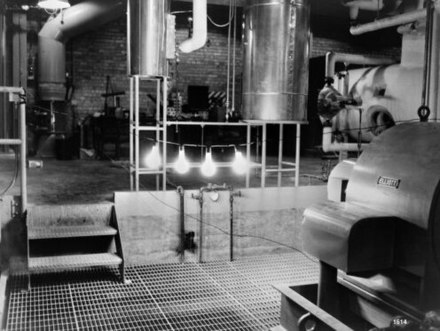
Experimental Breeder Reactor I (EBR-I) Arco, Idaho, U.S.
The real milestone in nuclear power history came with the Obninsk Nuclear Power Plant in the Soviet Union. Opened on June 27, 1954, Obninsk holds the title of the world’s first nuclear power station to generate electricity for a power grid.
Obninsk was a small-scale plant with a capacity of just 6 megawatts, it was cooled by water and moderated using graphite. Obninsk marked the dawn of a new era in energy production and was the precursor of the Chernobyl RBMK reactors.
Naturally, considering the warming politics of the cold war the Soviet Union proudly showcased it as a symbol of technological progress and a harbinger of the peaceful use of nuclear energy.
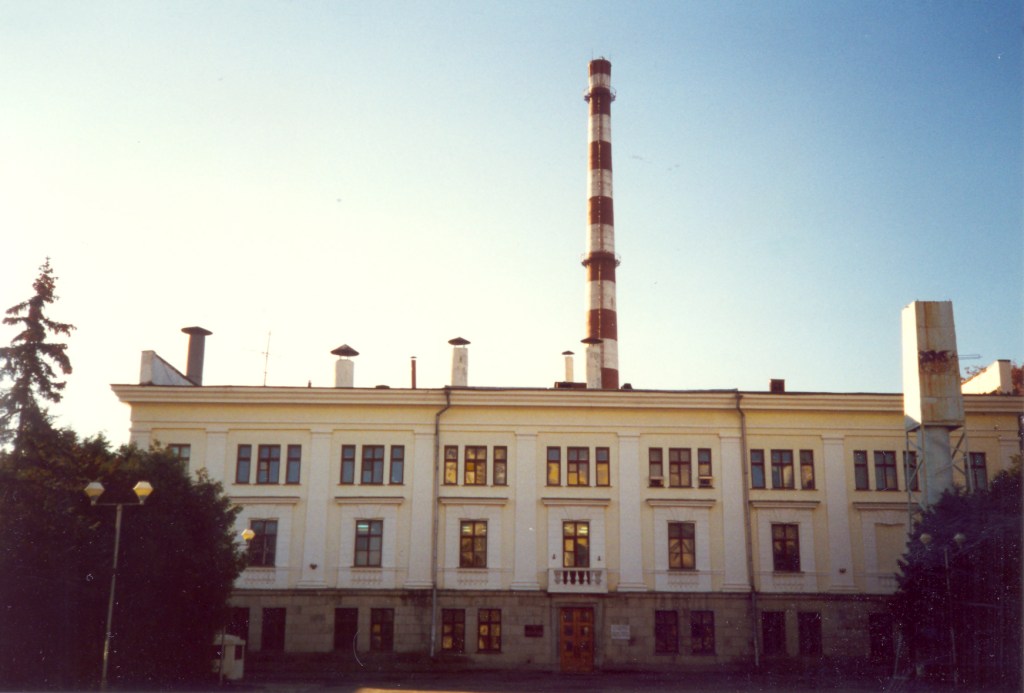
Obninsk Nuclear Power Plant, USSR
Small scale, mobile power generation also had its debut, as 1954 also saw the launching of the world’s first nuclear-powered submarine, the USS Nautilus which had a S2W pressurised water reactor of 10 megawatts.
Following closely behind the USSR, the United Kingdom opened Calder Hall in 1956. While Obninsk was primarily experimental, although it ran until 2002, Calder Hall was the first full-scale nuclear power plant designed for commercial electricity generation. Generating 50 megawatts, this Magnox reactor used natural uranium as fuel, graphite as a moderator and pressurised CO2 as a cooler.
Calder Hall marked the beginning of the nuclear age in the West and set the stage for further developments in the United States with the Shippingport Atomic Power Station, which came online in 1958.

Calder Hall, UK
Many of the first generation reactors were dual-use, serving both military and civilian purposes. While the technology was initially driven by military needs, especially for the production of weapons grade plutonium, the potential for peaceful application became increasingly apparent. Hence these early reactors were adapted or new ones were designed for civilian electricity generation.
First generation reactors were only operated in a limited number of countries, mainly those with advanced scientific and industrial capabilities, and include:
- Soviet Union (now Russia): Developed the first commercial nuclear power plant and several first-generation reactors, including the early RBMK and VVER reactors.
- United Kingdom: Developed the Magnox reactors, which were among the first commercial reactors in the world. Although Magnox reactor were originally designed to produce plutonium for the British nuclear weapons program
- United States: Developed some of the early commercial nuclear power plant and various experimental reactors, including the first-ever nuclear reactor, the Chicago Pile-1.
- Canada: Developed the early CANDU reactors, which used natural uranium and heavy water as a moderator.
- France: Initially developed gas-cooled reactors before shifting to pressurized water reactors.
- Germany: Developed and operated early experimental reactors.
- Japan: Imported technology and built early reactors based on designs from the United States.
- Italy: Developed and operated early reactors, though it later shifted its focus away from nuclear power.
First generation reactors were groundbreaking as they introduced the basic principles of nuclear fission for energy production, but they were also relatively simple and experimental by today’s standards. They often used natural uranium or low-enriched uranium as fuel and had varied designs, such as gas-cooled reactors in the UK and the first light water reactors (LWRs) in the U.S.
This period also saw the first prototypes of fast breeder sodium-cooled reactors : Enrico Fermi in 1963 (USA), Rhapsody in 1967 (France), BOR-60 in 1968 (Soviet Union), and later on that of Joyo in 1978 (Japan). The great advantage of these breeder reactors is their ability to generate more fissile material than they consume.
These early years taught the industry crucial lessons about reactor design, safety, and operational challenges. They highlighted the need for more robust safety systems, standardised designs, and better materials to handle the intense conditions within reactors.
1970-2009: Second generation reactors
Currently about 85% of the world’s nuclear electricity is generated by what are called “second-generation” reactors. And they were directly developed based on the lessons learned from the earlier generation. Yet global growth was dramatically slowed by the Three Mile Island accident in 1978, and again after Chernobyl in 1986.
The deployment of civilian nuclear power blossomed after the 1974 oil crisis. But it was in countries like Japan and France where it really took off. France in poarticular, was not alone in seeking energy independence within a volatile global political context, it had the benefit in that it could tap into uranium deposits held by its former (well technically) colonies.
By the late 1960s, uranium enrichment became available for civilian purposes, which was a massive game-changer, making it possible to use ordinary water in these reactors. Hence the development of light water reactors (LWRs). These reactors run on enriched uranium and use water not just for cooling, but also to slow down the neutrons.
There are two main subtypes:
- Pressurised Water Reactors (PWRs): These use water under high pressure as both a coolant and a neutron moderator. The water is kept under such high pressure that it doesn’t boil, even at high temperatures. The heat generated by the reactor is transferred to a secondary water circuit where steam is produced to drive turbines and generate electricity.
- Boiling Water Reactors (BWRs): In these reactors, water used as a coolant is allowed to boil inside the reactor vessel, producing steam directly to drive the turbine.
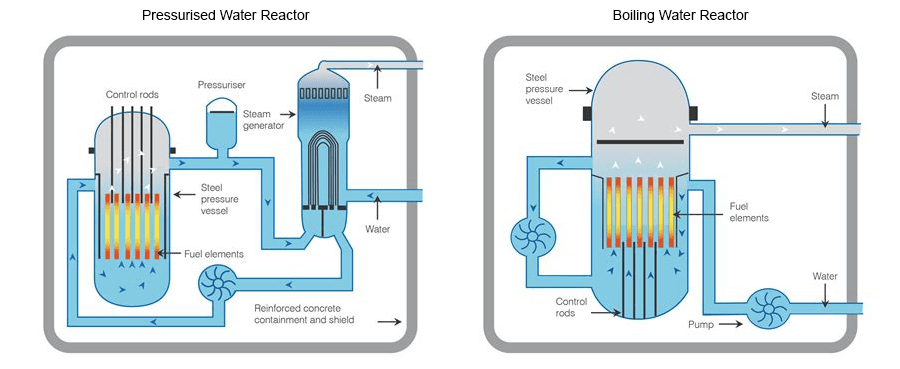
Second-generation reactors typically use enriched uranium as fuel, where the uranium-235 isotope is increased to about 3.5% to 5%. This enrichment allows for a more sustained and controlled nuclear reaction.
The fuel, in the form of uranium oxide (UO2) pellets, is encased in long zirconium rods. Zirconium, by the way, is great because it’s transparent to neutrons, kind of like a nuclear cloak of invisibility. In some reactors, they even mix in a bit of MOX, which is a blend of uranium and plutonium, giving them that extra fissionable kick.
These reactors generally use ordinary (light) water as both a coolant and a moderator. The water slows down the neutrons in the reactor to sustain the chain reaction efficiently.
Compared to first-generation reactors, second-generation reactors have better safety systems, including enhanced containment structures and redundant cooling systems designed to prevent or mitigate accidents.
In France, they went all-in, building a large uranium enrichment facility at Tricastin in the Rhône Valley. Originally based on gaseous diffusion, this method was eventually replaced by ultracentrifugation – fancy science speak for “we figured out a better way to do it.”
President Georges Pompidou made the call in 1969 to ditch the French first-generation gas-graphite reactors and switch to the more promising U.S. PWR design. Some critics thought this was a loss of national independence, but the decision paid off. Framatome, a company specialized in building these reactors, eventually developed its own purely French technology, proving that sometimes you’ve just got to license it before you can own it.
The French approach to reactor standardization was pretty clever. Ivan Stelin, a U.S. regulator, once quipped, “The French have 100 different cheeses and one plant model. We have the opposite!” It’s funny because it’s true.
Most of these second-generation reactors were built in developed countries like the U.S., EU nations, Japan, and South Korea, with construction peaking around 1980. After that, things slowed down—partly due to the aftermath of Three Mile Island in the U.S., more about that later, and partly because France had built enough reactors to meet its energy needs. But by 2000, the tide started turning again, with major Asian countries like China and India hopping on board the nuclear train with a shiny new third generation of reactors.
The UK took a different route, developing their own Advanced Gas-Cooled Reactor (AGR) technology, which uses slightly enriched uranium and graphite moderators. Canada, ever the innovator, improved their CANDU reactors, selling them off to countries like Argentina, China, and Romania. Meanwhile, the Soviet Union rolled out the RBMK reactors, the same type that was involved in the Chernobyl disaster, followed by their VVER pressurized water reactors – similar to the PWRs but with that Soviet twist.
By 2008, over 550 nuclear plants had been built world wide, generating a massive 372 gigawatts of electricity. To put that into perspective, that’s enough power for over 300 million homes. But many of these second generation reactors were beginning to show their age, with more than having 110 reaching their end-of-life. By this period the average reactor age was over 20 years, with many reaching their 30s and a few even their 40s.
But here’s the good news. Reactor performance has improved significantly. Today, the same amount of nuclear fuel can produce twice the energy it did 20 years ago. With better safety, reliability, and the ability to extend the reactors’ lives to 50 years, the future of nuclear power is looking brighter. Especially in the U.S., where more than half the opperating reactors have received life-extension approvals from the Nuclear Regulatory Commission (NRC), and plans for new reactors are on the horizon.
Who’s Who in the Nuclear World?
Nuclear power is currently generated in 32 countries, yet there are conflicting trends afoot about what’s next in the world of nuclear power generation.
Countries, such as China, India and Egypt are leading the charge in constructing new reactors and clearly see nuclear as a key ongoing component of their energy mix. Indeed, China is building more nuclear power plants than the rest of the world combined.
Yet many countries like Sweden or South Korea are clearly comfortable just maintaining what they have. Interestingly, a small number like Switzerland and Japan (for obvious reasons)are reassessing their nuclear commitment, or have phased out their nuclear capabilities altogether, i.e. Germany.
Countries with Nuclear Power Generation and Their General Approach:
- United States: The U.S. nuclear power industry is stable, with an emphasis on maintaining existing reactors and exploring advanced technologies, but faces competition from cheaper renewable energy sources. US nuclear power has a massive 95,835 MW capacity, some 18% of total national energy production.
- 93 operating reactors | 1 under construction
- France: France’s nuclear power industry is central to its energy mix, with a focus on maintaining and modernising its extensive reactor fleet, while also planning for future energy diversification. France is unique in that is produces about 65% of its electricity from nuclear power.
- 56 operating reactors | 1 under construction
- China: China’s nuclear power industry is rapidly expanding, with significant investments in new reactors as part of its strategy to reduce reliance on coal and meet growing energy demands. Nuclear currently only provides about 5% of total energy production.
- 55 operating reactors | 25 under construction
- Russia: Russia’s nuclear power industry is actively expanding, both domestically and internationally, with a strong emphasis on building new reactors and exporting nuclear technology. Note: The 6 reactors at the Zaporizhzhia NPP (annexed from Ukraine), are currently shut down.
- 37 operating reactors | 4 under construction | 6 shut down
- Japan: Japan’s nuclear power industry is slowly restarting post-Fukushima, and is facing public opposition and debates over its future role amid a push for renewables and over safety concerns.
- 32 operating reactors | 2 under construction
- South Korea: South Korea’s nuclear power industry is stable, with plans to maintain and expand its reactor fleet, despite ongoing debates about balancing nuclear energy with renewable sources.
- 26 operating reactors | 2 under construction
- India: India’s nuclear power industry is gradually expanding, with a focus on increasing capacity to meet growing energy needs while reducing reliance on fossil fuels.
- 19 operating reactors | 7 under construction
- Canada: Canada’s nuclear power industry is stable, with a focus on maintaining existing reactors and exploring small modular reactors (SMRs) as part of its clean energy strategy.
- 19 operating reactors | 0 under construction
- Ukraine: Ukraine’s nuclear power industry is crucial for its energy supply, despite challenges posed by the conflict with Russia, with efforts focused on maintaining operations and securing energy independence..
- 9 operating reactors | 2 under construction (6 annexed by Russia)
- UK: The UK’s nuclear power industry is in transition, focusing on maintaining existing plants while investing in new reactors as part of its strategy to achieve net-zero emissions.
- 9 operating reactors | 2 under construction
- Spain: Spain’s nuclear power industry is gradually winding down, with plans to phase out reactors by 2035 as the country shifts towards renewable energy sources.
- 7 operating reactors | 0 under construction
- Belgium: Belgium’s nuclear power industry is set to phase out by 2025, as the country transitions towards renewable energy and reduces its reliance on nuclear power.
- 6 operating reactors | 0 under construction
- Sweden: Sweden’s nuclear power industry remains a key part of its energy mix, with ongoing investments in maintenance and upgrades, while balancing nuclear energy with a strong focus on renewables.
- 6 operating reactors | 0 under construction
- Pakistan: Pakistan’s nuclear power industry is expanding, with efforts to increase capacity to meet growing energy demands and reduce reliance on imported fuels.
- 6 operating reactors | 1 under construction
- Czech Republic: The Czech Republic’s nuclear power industry is central to its energy strategy, with plans to expand capacity through new reactor projects while maintaining existing plants.
- 6 operating reactors | 0 under construction
- Finland: Finland’s nuclear power industry is growing, with recent reactor additions and plans to further expand as part of its strategy to achieve energy security and reduce carbon emissions.
- 5 operating reactors | 0 under construction
- Slovakia: Slovakia’s nuclear power industry is a cornerstone of its energy supply, with ongoing efforts to expand capacity through new reactor projects while maintaining existing facilities.
- 5 operating reactors | 1 under construction
- Hungary: Hungary’s nuclear power industry is expanding, with plans to build new reactors to ensure long-term energy security and reduce reliance on fossil fuels. Preparatory work has begun to extend the life of the four operating units until the mid-2050s
- 4 operating reactors | 0 under construction
- Switzerland: Switzerland’s nuclear power industry is in gradual decline, with plans to phase out existing reactors by the end of their lifespan, focusing instead on renewable energy sources.
- 4 operating reactors | 0 under construction
- Argentina: Argentina’s nuclear power industry is stable, with ongoing efforts to maintain existing reactors and plans to expand capacity as part of its broader energy strategy.
- 3 operating reactors | 1 under construction
- Tiawan: Taiwan’s nuclear power industry is being phased out, with plans to shut down all reactors by 2025 as the country shifts towards renewable energy.
- 3 operating reactors | 1 under construction
- Belarus: Belarus’s nuclear power industry is in its early stages, with the recent launch of its first NPP as part of a strategy to reduce energy dependence on imported fuels.
- 2 operating reactors | 0 under construction
- Brazil: Brazil’s nuclear power industry is stable, with plans to expand capacity through new reactor projects while continuing to rely on a mix of energy sources.
- 2 operating reactors | 1 under construction
- Bulgaria: Bulgaria’s nuclear power industry is a key part of its energy mix, with plans to maintain and potentially expand its reactor fleet to ensure energy security.
- 2 operating reactors | 0 under construction
- Mexico: Mexico’s nuclear power industry is limited but stable, with a focus on maintaining its existing reactors while exploring options for future energy diversification.
- 2 operating reactors | 0 under construction
- Romania: Romania’s nuclear power industry is crucial to its energy supply, with plans to expand capacity by building new reactors and extending the life of existing ones. Romania plans to be the first European country outside of the US and Russia to have workable small modular nuclear reactor (SMR) technology.
- 2 operating reactors | 0 under construction
- South Africa: South Africa’s nuclear power industry is small but significant, with ongoing debates about expanding nuclear capacity as part of the country’s energy strategy amid challenges with its aging infrastructure.
- 2 operating reactors | 0 under construction
- Armenia: South Africa’s nuclear power industry is small but significant, with ongoing debates about expanding nuclear capacity as part of the country’s energy strategy amid challenges with its aging infrastructure.
- 1 operating reactor | 0 under construction
- Iran: Iran’s nuclear power industry is expanding, with ongoing efforts to increase capacity through new reactor projects as part of its broader energy strategy, despite international scrutiny.
- 1 operating reactor | 1 under construction
- Netherlands: The Netherlands’ nuclear power industry is limited but gaining renewed interest, with plans to build new reactors as part of efforts to reduce carbon emissions and diversify the energy mix.
- 1 operating reactor | 0 under construction
- Slovenia: Slovenia’s nuclear power industry is a key part of its energy strategy, with plans to extend the life of its existing reactor and potentially build a new one to ensure long-term energy security.
- 1 operating reactors | 0 under construction
- Bangladesh: Bangladesh’s nuclear power industry is in its early stages, with its first nuclear power plant under construction, aiming to meet growing energy demands and reduce reliance on fossil fuels.
- 0 operating reactors | 2 under construction
- Egypt: Egypt’s nuclear power industry is in development, with plans to build El Dabaa Nuclear Power Plant, its first NPP as part of a strategy to diversify its energy sources and meet growing electricity demands.
- 0 operating reactors | 4 under construction
- Turkey: Turkey’s nuclear power industry is emerging, with the construction of its first NPP underway as part of efforts to reduce energy imports and diversify its energy mix.
- 0 operating reactors | 4 under construction
Nuclear power was used in Germany from the 1960s until it was fully phased out in April 2023.
The Future is Bright: New Nuclear Players, Technologies and Projects
Several countries are considering building their first nuclear power plants, venturing into nuclear energy as a new addition to their energy mix. Here are some of them:
- Saudi Arabia: Saudi Arabia is in the planning phase for its first nuclear power plant, aiming to diversify its energy mix and reduce dependence on oil for electricity generation.
- Jordan: Jordan has been considering building its first nuclear power plant for several years as part of its efforts to address energy security and reduce its reliance on imported energy.
- Kenya: Kenya is exploring the possibility of building its first nuclear power plant, seeing it as a way to meet the country’s growing energy demands and diversify its energy sources.
- Uzbekistan: Uzbekistan is planning to build its first nuclear power plant with Russian assistance, as part of its strategy to modernize its energy infrastructure and meet growing electricity needs.
- Kazakhstan: Kazakhstan, a country rich in uranium resources, has been exploring the possibility of up to three NPPs as part of its long-term energy strategy. Four companies are reportedly being considered for construction: Électricité de France, Rosatom, China National Nuclear Corporation and Korea Hydro & Nuclear Power Co. Interestingly the proposition to go nuclear is being put to the people via a referendum.
- Philippines: The Bataan Nuclear Power Plant (BNPP), constructed in the 1980s, has been a focal point of discussion. The plant was completed but never operated due to safety concerns and political opposition. In recent years, there have been renewed discussions about rehabilitating and possibly operating the BNPP to address the country’s energy needs.
- Ghana: Ghana has been considering nuclear power since the early 2000s. The Ghana Atomic Energy Commission (GAEC) has been leading the efforts to explore the feasibility of nuclear energy as a sustainable option for the country’s future energy mix.
- Kenya: The Ghana Nuclear Power Programme Organization (GNPPO) was established to oversee the country’s efforts in developing nuclear power. The government has been working with the International Atomic Energy Agency (IAEA) to assess its readiness and establish the necessary infrastructure for nuclear energy.
- Morocco: The Moroccan government, through its National Office of Electricity and Drinking Water (ONEE), has conducted feasibility studies to assess the potential for nuclear power development. These studies have focused on site selection, safety, environmental impact, and economic viability.
- Nigeria: Nigeria faces significant energy challenges, including frequent power outages and a heavy reliance on fossil fuels, particularly natural gas and oil. The government views nuclear power as a potential solution to provide a stable, reliable, and large-scale source of electricity to meet the growing demand.
- Namibia: The country’s arm of Russian nuclear giant Rosatom is working towards the construction of Namibia’s first nuclear power plant.
- Burkina Faso: Initial discussions are being held with Russian state nuclear corporation Rosatom about potential capacities and locations.
- Australia: The opposition Liberal Party has announced they will go to the next election promising to build seven nuclear power stations. It’s a little known fact, but Australia did break ground for a 600 MWe NPP at Jervis Bay, allegedly as part of a secret but aborted nuclear weapons program. But it was cancelled in 1971 under new Prime Minister William McMahon who found it inconsistent with the goals of the Nuclear Non-Proliferation Treaty,
- The Moon: Roscosmos chief Yuri Borisobundant recently revealed that work is underway on a Russian-Chinese lunar NPP, expected to be delivered to the Moon in the 2030s.
Third Generation and Emerging Technologies
Concevied from the late 1990s, third-generation reactors are expected to gradually replace the second-generation reactors currently in service. This new generation incorporates evolutionary improvements in design such as improved fuel technology, higher thermal efficiency, significantly enhanced safety systems (including passive nuclear safety), and standardised designs intended to reduce maintenance and capital costs.
Some “evolutionary” models proposed by the main reactor manufacturers include.
Boiling water reactors: ABWR (Advanced BWR) and ESBWR (Economic Simplified BWR) of General Electrics-Hitachi.
Pressurised water reactors: Westinghouse-Toshiba’s Advanced PWR (AP-1000), AREVA’s European Evolutionnary PWR (EPR), Russian (VVER-1200) from Rosatom and Canadian heavy water CANDU (ACR-1000).
In addition, several emerging technologies in the nuclear power industry are being developed to make nuclear energy safer, more efficient, and more flexible. Here’s a rundown of some of the most promising innovations:
- Small Modular Reactors (SMRs): These mini-reactors are all the rage. They’re cheaper, faster to build, and offer enhanced safety features, making them a popular choice for countries looking to dip their toes in the nuclear pool. However, as of 2024, only China and Russia have successfully built operational SMRs. Russia has been operating a floating nuclear power plant, the Akademik Lomonosov, while China’s pebble-bed modular high-temperature gas-cooled reactor HTR-PM, was connected to the grid in 2021.
- Thorium Reactors: The elusive thorium reactor promises cleaner and more abundant fuel sources. Although still in the research phase, many believe it could revolutionize the industry.
- Fusion Power: Often considered the holy grail of energy, fusion promises limitless clean energy. While commercial fusion power remains a distant dream, recent advances suggest it might not be as far off as we once thought.

The Akademik Lomonosov floating SMR, docked in Pevek harbour.
The Dirty Risky Gamble
New nuclear power plants are like the overprotective parents of the energy world. They’ve had to be because, let’s face it, nobody wants a meltdown in their backyard. Early designs were rudimentary and lacked many of the complex safety features we see today. That safety really matters is a lesson that industry, and the public at large learned the hard way.
Hard Won Lessons
- Three Mile Island (1979): This was the first major wake-up call. A partial meltdown in Pennsylvania brought the U.S. nuclear industry to a halt and turned “nuclear” into a four-letter word. But it also spurred improvements in training, emergency response, and reactor design.
- Chernobyl (1986): The mother of all nuclear disasters, Chernobyl was the result of a perfect storm of poor design, operator error, and a blatant disregard for safety protocols. The world watched in horror as reactor number four blew its top, spewing radioactive material across Europe. The disaster led to widespread changes in international nuclear safety standards. Fun fact: Interestingly, the Kursk NPP that the Ukrainians are currently sending explosive drones towards uses RBMK-1000 reactors of the same non-enclosed design.
- Fukushima (2011): Nature reminded us who’s boss when an earthquake and tsunami caused multiple reactor failures in Japan. This led to a reevaluation of safety measures worldwide, especially concerning natural disasters. The incident also accelerated the push for newer, safer reactor technologies.
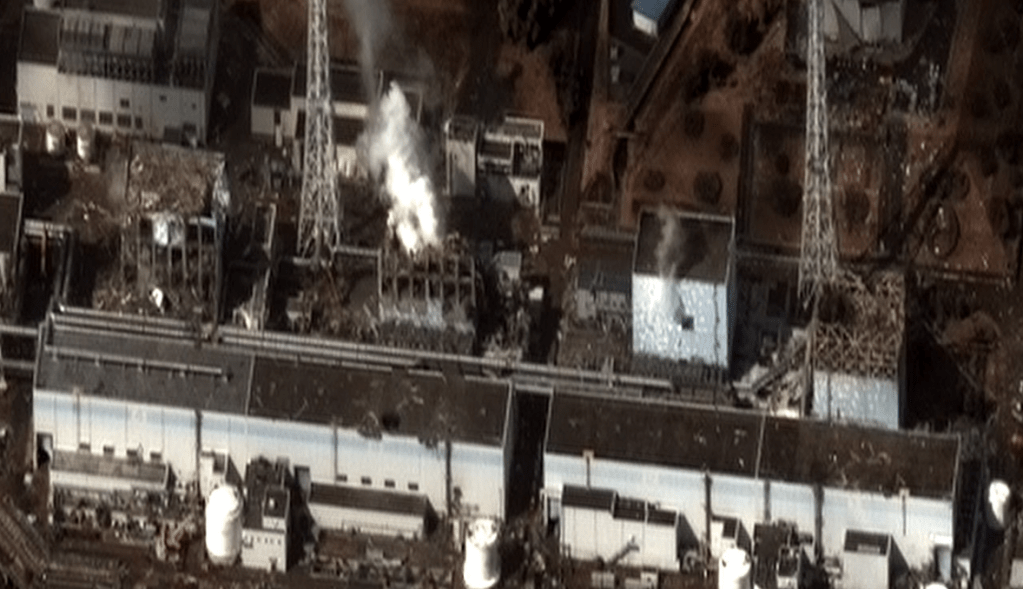
The Fukushima I Nuclear Power Plant after the 2011 Tōhoku earthquake and tsunami. Reactor 1 to 4 from right to left.
The Nuclear vs. Renewable Debate
Now, here’s where things get complex. While solar and wind power are often touted as the ultimate green energy solutions, they have their downsides – like the fact that the sun doesn’t always shine, and the wind doesn’t always blow. Nuclear power, on the other hand, offers a steady and reliable energy source with a significantly smaller land footprint, it also doesn’t tend to look ugly or chop up flying critters. But putting aesthetics and animal welfare aside, there are four big issues that need to be addressed.
The first 300 Pound Gorilla: Baseload Power
The first gorilla to discuss is baseload power. Baseload power refers to the minimum continuous level of electricity demand that must be met by the power grid at all times, regardless of fluctuations in daily or seasonal energy use.
This demand is typically met by power plants that can operate reliably and efficiently 24/7, such as nuclear, coal, and large hydroelectric plants, which are designed to run continuously at full capacity.
Baseload power plants provide the stable and consistent electricity supply needed to keep essential services and infrastructure running, even when demand is low, ensuring the overall reliability and stability of the electrical grid.
The main problem with renewables and baseload power is that renewable energy sources like wind and solar are intermittent and require significantly more capacity to reliably cover baseload demand.
The excess ratio required for renewable energy sources to reliably cover baseload power typically ranges from 2 to 3 times the capacity compared to traditional baseload power plants like coal, gas, or nuclear.
This means that to generate the same amount of reliable electricity as a 1,000 MW coal or nuclear plant, you might need 2,000 to 3,000 MW of installed wind or solar capacity, due to the intermittent nature of these renewable sources. This excess capacity is necessary to account for periods when the renewable sources are producing less than their maximum potential and to ensure enough power is available even during low-generation periods. This issue is compounded by the fact that storing power is still not cost effective at scale.
The second 300 Pound Gorilla: Peak Power
The second gorilla we need to adress is how you deal with power peaks, which are periods when electricity demand is higher than usual.
Gas-fired power plants, particularly those using natural gas combined cycle (NGCC) or simple cycle gas turbines (SCGT), are highly flexible and can ramp up or down quickly. This makes them well-suited for meeting peak demad.
Some coal plants may operate at a slightly reduced capacity during off-peak times so that they can ramp up a bit when demand increases. However, they are generally not the first choice for meeting short-term peak demand because of their slow response time.
Interestingly nuclear reactors are not typically used to manage peak demand because they are less flexible and have long ramp-up and ramp-down times. Which is one of the reasons that experts talk about the requirement of having a generation mix within an energy grid.
The problem with renewables in dealing with peak consumption is that their intermittent nature makes it difficult to reliably meet sudden increases in demand, requiring either substantial overbuilding of capacity, which is costly and inefficient, or reliance on backup systems like fossil fuels or expensive energy storage solutions, which can undermine the environmental and economic benefits of renewables.
Additionally, as per baseload generation, current energy storage technologies are often insufficient to handle prolonged peak periods, making it challenging to balance supply and demand consistently.
The third 300 Pound Gorilla: Transmission Costs
A nuclear reactor, even a biggish 1,100 megawatt facility like a Westinghouse AP1000, has a really small physical footprint. And if you are decommissioning a coal power plant you could literally put a modular nuclear reactor in the old carpark. In both cases you can easily reuse all the existing power transmission infrastructure.
But renewables, be it solar farms or windmills, often have to be located in remote areas. Connecting these power sources to the existing power grid can be significantly expensive, especially if you are talking about offshore locations, i.e. windmills in the sea.
The Fourth 300 Pound Gorilla: Waste
Of course, the radioactive elephant in the room is waste disposal. But with advancements in recycling and waste reduction technologies, the future of nuclear waste management looks promising.
Conclusion: The Road Ahead
As we navigate the murky waters of energy policy and climate change, nuclear power remains a potent – if controversial – player. With advancements in safety and technology, it offers a viable alternative to more environmentally invasive energy sources. So, whether you’re a nuclear skeptic or a fervent supporter, one thing is clear: nuclear power is here to stay, and its role in our energy future is far from over.



 The Lowdown
Leave a comment